
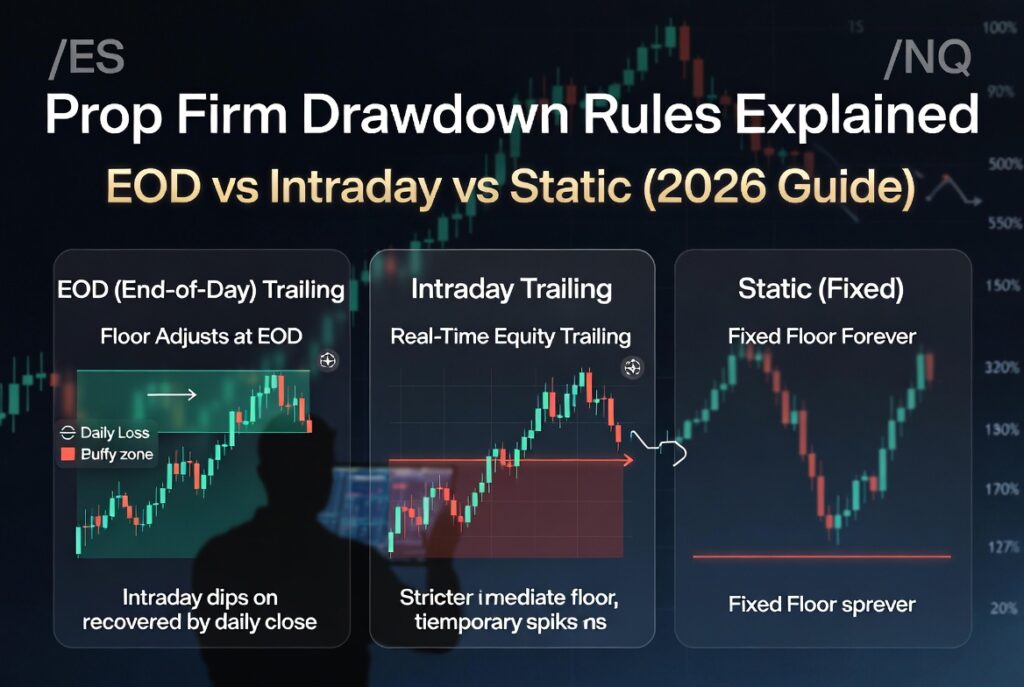
If you’ve ever had a prop firm account closed and wondered exactly what triggered it — the answer almost always comes back to the drawdown rules. Understanding how drawdown works isn’t optional. It’s the single most important thing to master before you put money into any evaluation.
This guide breaks down every drawdown type used by modern prop firms, with real examples showing exactly how each one works in practice.
What Is Drawdown in Prop Trading?
Drawdown is the maximum loss your account is allowed to sustain before the firm closes it. Exceed this limit and your account is terminated — regardless of how profitable you were before.
Every prop firm has a drawdown rule. The type of drawdown rule is often the difference between a fair, tradeable account and one that gets you blown out by normal market volatility.
There are three primary types:
- EOD (End-of-Day) Trailing Drawdown
- Intraday Trailing Drawdown
- Static (Fixed) Drawdown
Type 1: EOD (End-of-Day) Trailing Drawdown
This is the most common drawdown type on the market and generally the most beginner-friendly.
How It Works
Your drawdown limit is calculated based on your highest end-of-day balance — meaning it only adjusts at market close, not during the trading session.
Example:
- Starting balance: $50,000
- Max drawdown: $2,000 (meaning your account closes if balance drops to $48,000)
- You trade on Day 1 and end the day at $51,500
- Your new drawdown floor rises to $49,500 (i.e., $51,500 – $2,000)
- Day 2 opens: you have a bad session and drop to $50,200 intraday
- No problem — you haven’t touched your floor of $49,500
- Day 2 closes at $50,200 — your floor doesn’t move (you didn’t make a new EOD high)
- Day 3: you hit $52,000 EOD — floor rises to $50,000
Key Feature: Intraday Dips Don’t Count
The critical advantage of EOD trailing: if you’re down $1,800 mid-day but recover to flat by close — your drawdown floor hasn’t moved. You only pay the price if you actually close the day in the red below your previous high.
Who Uses It
Most major firms: Tradeify, GOAT Funded Futures (EOD plans), Blue Guardian Futures, AquaFutures (Standard), The Legends Trading, The Prop Pit.
Type 2: Intraday Trailing Drawdown
This is the strictest common drawdown type. It follows your account equity in real-time — not just at end of day.
How It Works
Your drawdown floor adjusts whenever your equity hits a new high — even during open trades.
Example:
- Starting balance: $50,000
- Max trailing drawdown: $2,000
- Your floor starts at $48,000
- You open a trade and it moves in your favor to an unrealized P&L of +$1,500 (equity = $51,500)
- Floor immediately rises to $49,500
- The trade then reverses. You close it at breakeven.
- Your floor is now $49,500 — even though you didn’t actually make any money
- You’re now $500 closer to being stopped out, despite not having a losing trade
Why It’s Harder
Intraday trailing penalizes you for unrealized gains that don’t close. A trade can go up, come back to flat, and still tighten your drawdown buffer. This catches many traders off guard.
Who Uses It
AquaFutures Pro tier, some Apex Trader Funding plans, various other firms’ premium tiers.
Type 3: Static (Fixed) Drawdown
The most forgiving drawdown type — and the simplest to understand.
How It Works
Your maximum loss is a fixed dollar amount from your starting balance. It never moves, up or down.
Example:
- Starting balance: $50,000
- Static drawdown: $2,500
- Your account closes if balance ever drops below $47,500
- If you grow your account to $55,000, your floor is still $47,500
- You could theoretically lose $7,500 from peak without being stopped out
Key Feature: The Floor Never Rises
With static drawdown, your buffer only grows as your account grows — it never shrinks due to a new equity high. This gives traders the most room to survive drawdown periods.
The Downside
Because the floor doesn’t trail upward, you can lose significant profits before getting stopped out. For firms, this is higher risk — hence static drawdown is less common and usually found on specific account types.
Type 4: EOD Static (Hybrid)
Some firms use a hybrid approach: a static floor that locks in gains at EOD but doesn’t trail intraday.
How It Works
Similar to EOD trailing, but the floor only moves to lock in a certain % of your gains — not dollar-for-dollar.
Example:
- Account: $50,000
- EOD static drawdown: locks floor at 50% of EOD gains
- You end Day 1 at $52,000 → floor moves to $49,000 (not $50,000)
- You still have a larger buffer than pure EOD trailing
This is a less common structure but exists at some firms as a “pro” account variant.
Daily Loss Limit — The Additional Rule
Many firms layer a daily loss limit on top of the main drawdown rule. This caps how much you can lose in a single day.
Example:
- Account: $50,000
- Max drawdown: $2,000 (EOD trailing)
- Daily loss limit: $500
Even if your EOD floor is at $49,500, you can’t lose more than $500 in a single session. Hit the daily limit and your trading is blocked for the rest of that day.
Firms With No Daily Loss Limit
Some firms remove the daily limit entirely for more flexible trading:
- The Legends Trading (Elite plan) — no daily loss limit
- Blue Guardian Futures (Guardian tier) — no daily loss limit
- AquaFutures (One-Step Standard) — no daily loss limit
- GOAT Funded Futures (EOD plans) — no daily loss limit
Head-to-Head Comparison Across Major Firms
| Firm | Drawdown Type | Daily Loss Limit | $50K Drawdown |
|---|---|---|---|
| Tradeify | EOD Trailing | Yes | Varies by plan |
| The Prop Pit | EOD | EOD mode | Transparent |
| AquaFutures (Standard) | EOD | Yes (2.5%) | $2,000 (4%) |
| AquaFutures (Pro) | Trailing | None | $2,000 (4%) |
| Blue Guardian (Standard) | EOD | Yes ($1,250) | $2,500 (5%) |
| Blue Guardian (Guardian) | EOD | None | $2,000 (4%) |
| GOAT Funded Futures | EOD | None | $2,000 (4%) |
| The Legends Trading (Elite) | EOD Trailing | None | $2,200 (4.4%) |
Which Drawdown Type Should You Choose?
Choose EOD Trailing if:
- You’re an intraday trader who takes and closes positions within the session
- You want protection from intraday volatility counting against you
- You’re newer to funded trading
Choose Intraday Trailing if:
- You fully understand the risk and want a lower account cost
- You trade with tight risk management and rarely let winners reverse significantly
- You’re an experienced trader comfortable with the stricter rules
Choose Static if:
- You’re a swing trader holding positions for multiple days
- You want maximum buffer and can tolerate higher cost
- You expect drawdown periods as part of your normal strategy
Choose No Daily Loss Limit if:
- Your strategy can have single losing days but recovers over the week
- You don’t want arbitrary daily cutoffs disrupting your trading
The #1 Drawdown Mistake Traders Make
Not accounting for the trailing effect on winning trades.
Many traders only think about the drawdown when they’re losing. But with trailing drawdown (especially intraday), your floor rises every time you profit. This means later in your evaluation, when your account is up significantly, your buffer is actually smaller — because the floor has trailed up close to your current equity.
Practical rule: As you get closer to your profit target, reduce position size. Your remaining drawdown buffer is likely tighter than when you started.
Final Thoughts
Drawdown rules are the engine of every prop firm evaluation. Choose the wrong type for your trading style and even a profitable strategy will fail. Choose correctly and the rules become almost invisible.
The safest starting point for most traders: EOD trailing, no daily loss limit, 4-5% max drawdown. That combination — offered by firms like GOAT Funded Futures, The Legends Trading Elite, and Blue Guardian Guardian tier — gives you the most room to trade your strategy without artificial constraints.
Understand the rules before you pay. Trade them before you push.